
Accessibility plan
The guiding framework for our accessibility plan covers the following key areas:
- Our areas of focus for accessibility
- Our principles
- Legislation and regulation cornerstones
- Our existing policies and plans
- Our vision statement and service commitment
View a PDF version of our accessibility plan below:
To review our progress, view a PDF version of our accessibility plan progress report below:
Statement of commitment to accessibility
A note about language:
Legal Aid BC (LABC) recognizes that accessibility is an emerging field with diverging perspectives about disability language. To honour both person-first language preferences and identity-first preferences, we have alternated between the two throughout this statement.
Legal Aid BC is committed to providing an accessible and inclusive organization that is welcoming, safe, and respectful to everyone. We aim to identify, remove, and prevent barriers so that people with disabilities, and everyone, can fully and equally access our services and interact with our organization. We respect and uphold the requirements, principles, and standards that are outlined in the Accessible BC Act.
We are working to increase the accessibility of our spaces, policies, and practices. We strive to remove negative attitudes and intersecting forms of discrimination that have traditionally created barriers for disabled people. We acknowledge that by limiting or removing barriers, everyone benefits.
We recognize that it takes time, dedication, and focused action to make change. To learn more about the current areas of focus in our commitment towards greater accessibility and inclusion, please see the action items in our Accessibility Plan (PDF).
This is a work in progress so if you, or someone you know, experience a barrier to accessibility or inclusion within our organization, please make us aware by using the feedback method below.
We want to hear from you!
We welcome your feedback to help us improve. You can provide feedback anonymously or include your contact information if you’d like a response. All feedback is reviewed and helps inform LABC’s ongoing accessibility efforts.
You can provide feedback about:
- barriers you’ve experienced when accessing our in-person services, websites, or communications
- suggestions for improving accessibility
- our Accessibility Plan or progress on accessibility initiatives
Legal Aid BC (LABC) is committed to providing digital accessibility for people with disabilities and creating a positive online experience for all visitors, in line with the Web Content Accessibility Guidelines (WCAG) 2.2, level AA.
While we have implemented measures to meet those standards, some limitations may still exist. We welcome your feedback to help us improve. You can provide feedback anonymously or include your contact information if you’d like a response. All feedback is reviewed and helps inform LABC’s ongoing accessibility efforts.
Web accessibility means designing and developing websites, applications, and digital content that everyone can use. This aligns with Legal Aid BC’s vision of transforming the province’s legal system into one that is equitable and inclusive, especially for those facing barriers to accessing justice.
Accessible digital environments empower individuals with disabilities to fully participate in society. Legal Aid BC emphasizes inclusion, adaptability, and self-determination as core principles. We recognize that accessibility benefits both people with permanent disabilities and those with temporary or situational limitations.
We acknowledge the importance of legislation and regulation cornerstones, such as the Accessible British Columbia Act and the Human Rights Code, which mirror the global push for compliance with standards like the Web Content Accessibility Guidelines (WCAG) 2.2.
An accessible website or application includes features such as:
- semantic and well-structured content that works well with screen readers and other assistive technologies. This aligns with Legal Aid BC’s focus on accessible information.
- keyboard navigation so that users who cannot use a mouse have access. This reflects Legal Aid BC’s commitment to inclusive technology.
- high contrast and readable text that helps users with low vision. This is consistent with our emphasis on universal design.
- text alternatives for images, videos, and other non-text content. This also aligns with our focus on accessible information.
- clear and consistent design to support understanding and navigation. This enhances usability and supports Legal Aid BC’s principle of adaptability.
Creating accessible experiences is ongoing. Legal Aid BC’s Accessibility Plan 2026 – 2030 (PDF) includes monitoring and evaluating progress by using feedback and collaboration to improve accessibility across employment, service delivery, and digital platforms.
The Legal Aid BC Vancouver Regional Centre, which includes an Intake office where you can apply for legal aid in person, is located at 510 Burrard Street (4th floor) in the Scotiabank building at the corner of Burrard Street and Pender Street. We’re in a 14-storey concrete and glass office building, accessed by low steps and ramps.
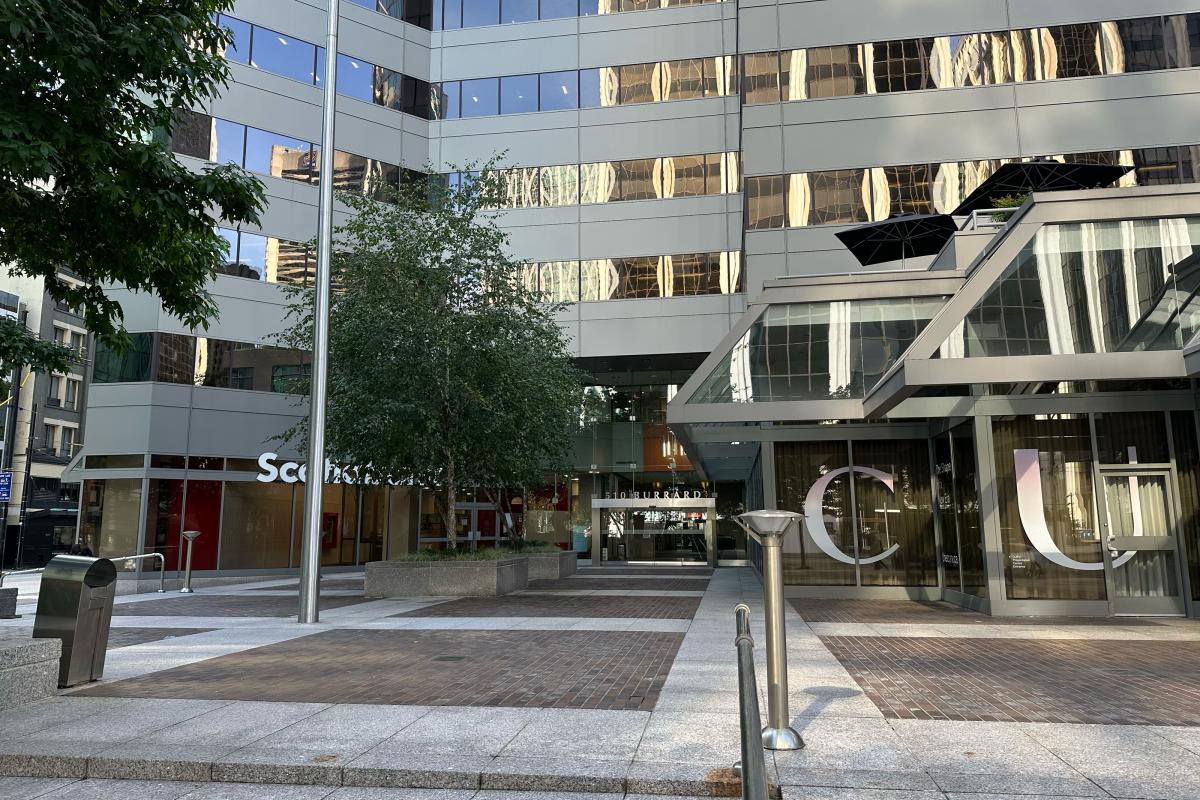
The main entrance is on Burrard Street with a backside entrance on Hornby Street. Both entrances have accessible automatic doors.
For more information to help you plan your visit, see these instructions.